Stance KB US Conservation
Investing in American companies leading the way for nature.
Provide US equity exposure by investing in those companies that lead their industries in managing their biodiversity and nature-based risks, designed to align with Catholic values with no exposure to pharmaceuticals or fossil fuels.
The Stance KB US Conservation Strategy invests in domestic companies demonstrating leadership in managing their biodiversity impacts, risks, and dependencies. According to PwC, more than half of global GDP, approximately $58 trillion, is moderately or highly dependent on nature.¹ We believe companies that best manage their interdependencies with the natural world are better positioned to create durable long-term value.
The strategy employs a proprietary, bottom-up research process to identify biodiversity leaders. Companies are benchmarked using industry-specific models built around key performance indicators spanning biodiversity, land stewardship, water use, and ecosystem impacts. Fundamental financial analysis is then applied to evaluate growth prospects, financial strength, and valuation, producing a portfolio that reflects both nature-positive leadership and investment quality.
How the portfolio is built.
Industry Identification and Exclusion
Stance analysts apply exclusionary screens to constituents of the developed markets to eliminate those industries determined to have categorically harmful societal impacts (e.g., tobacco, gambling, alcohol, and fur).
Proprietary Benchmarking
Companies in industries with material impacts are benchmarked using proprietary models with key performance indicators for biodiversity-related policies, practices, and performance.
Controversy Review
All industry leaders are systematically screened and graded for controversies, with those involving ecosystem destruction, biodiversity harm, and violations of indigenous land rights weighted most heavily.
Financial Analysis
Each security passing the biodiversity screen is subject to a fundamental review across growth, profitability, financial health, and valuation criteria. Position sizes are capped at 5% and industry concentration limited to 15%.
WHY CONSERVATION?
More than one million species are currently threatened with extinction,² with nature's decline accelerating at rates unprecedented in human history. Nature loss is concentrated in industries with the largest land and resource footprints: infrastructure, agriculture, and extractives. Scientists have identified five primary drivers behind the crisis, each directly influencing how we evaluate companies.
Nature underpins the physical economy in ways that rarely appear on balance sheets. Land-based ecosystems, freshwater systems, and biodiversity support agricultural output, clean water supply, and the raw material supply chains on which US industry relies. The World Bank estimates that a collapse of key ecosystem services, including wild pollination, marine fisheries, and native timber, could cost the global economy $2.7 trillion annually by 2030.³ Companies with large land and resource footprints face growing exposure as these systems come under pressure.
For investors, this creates material risk. Regulatory frameworks around land use, water rights, and biodiversity disclosure are tightening at both the federal and state level. Companies that fail to manage their nature-related dependencies face operational disruption, stranded assets, and increasing scrutiny from regulators and capital allocators alike. We believe identifying those best positioned to navigate this transition is central to sound portfolio construction.

Land & Sea Use
Conversion of forests and wetlands is the single largest driver of species loss.

Resource Exploitation
Direct exploitation is the second-largest driver on land. Overexploitation threatens thousands of wild species, from unsustainable hunting and harvesting to resource extraction.

Climate Change
Rising temperatures destabilize ecosystems globally, threatening one in six species at current warming trajectories.

Pollution & Invasive Species
Chemical runoff, plastic waste, and the spread of invasive species have contributed to nearly 40% of all recorded animal extinctions.
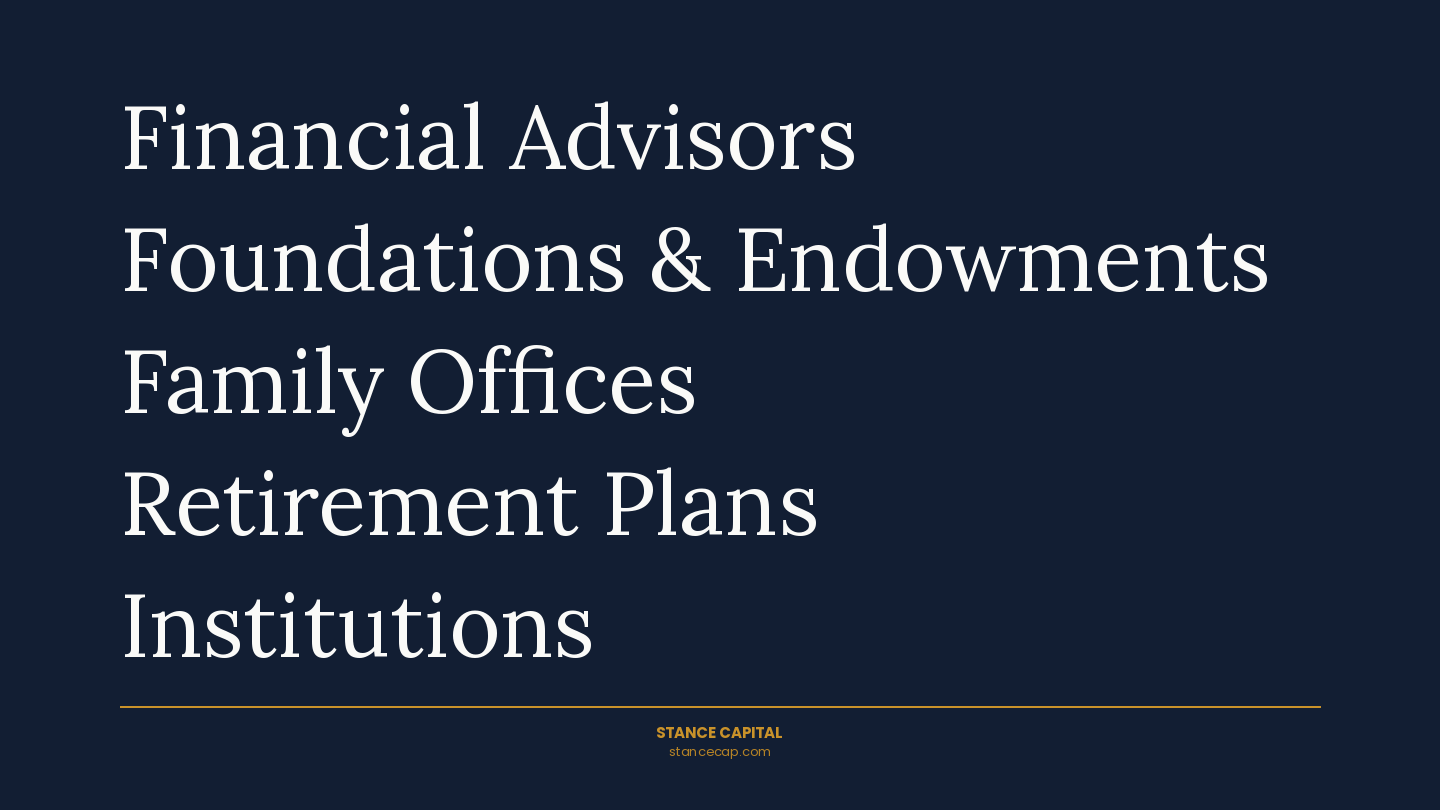
The right fit for the right client.
The Stance KB US Conservation Strategy gives advisors a research-rigorous equity offering for clients who want to align capital with nature-positive outcomes without sacrificing investment quality. As biodiversity moves toward a mainstream risk factor, advisors who can offer this exposure will be ahead of client demand.
Endowments with long investment horizons are uniquely positioned to benefit from strategies that price in risks the market has not yet fully recognized. For endowments with environmental or conservation missions, the Stance KB US Conservation Strategy also offers alignment between the investment portfolio and institutional values in a form that is analytically defensible, not merely aspirational.
Family offices investing across generations understand that the economic systems underlying long-term wealth creation are inseparable from the natural systems that support them. As US land, water, and biodiversity come under increasing pressure and domestic conservation regulations tighten, the companies best managing their nature dependencies and impacts are those best positioned to navigate that transition.
Available where you already work.
30 minutes.
An honest assessment.
We’ll ask about your client base, your platforms, and the situations you’re trying to solve. We’ll tell you directly whether this strategy is the right fit.
Contact Stance CapitalPerformance data & strategy documentation
Complete performance history, portfolio characteristics, risk metrics, and compliance disclosures are available in the strategy documents below.
Documents coming soon
How does Stance KB US Conservation differ from Stance KB Global Biodiversity beyond geography?
US-listed companies operate within a specific regulatory environment, including EPA standards, the Endangered Species Act, and federal land-use policy, that shapes both their conservation risks and opportunities.We evaluate companies against that backdrop, which introduces considerations that do not arise in the same way globally. The result is a strategy built around the US-specific conservation opportunity set.
Is conservation-focused investing viable without sacrificing financial returns?
We believe so. Companies leading their US peers on conservation tend to have stronger operational discipline, better long-term risk management, and more durable relationships with regulators and communities. Conservation leadership is rarely incidental. It reflects institutional capacity, and our fundamental overlay seeks to identify companies that pair that leadership with sound financial characteristics.
How might this fit into a broader portfolio?
The strategy is designed for investors seeking US equity exposure that integrate conservation objectives with disciplined fundamental investment analysis. It may complement a broader domestic equity allocation for investors who want their capital to reflect nature-related values and, in our view, to be better positioned as nature-related risks are more fully priced by the market. Investors should consult their advisor about the appropriate role in their specific portfolio.
Is Stance Capital GIPS compliant?
Yes. Stance Capital is independently verified for GIPS compliance by ACA Compliance Group. Performance results are presented gross and net of management fees, and GIPS composite data is available upon request.
Go deeper on what drives this strategy.
¹ WWF, Global Trade Analysis Project at Purdue University, and the Natural Capital Project. Global Futures: Assessing the Global Economic Impacts of Environmental Change to Support Policy-Making. February 2020. https://www.worldwildlife.org/news/press-releases/new-wwf-report-reveals-us-will-suffer-worlds-biggest-economic-impact-due-to-nature-loss.
² United Nations. "Nature's Dangerous Decline 'Unprecedented'; Species Extinction Rates 'Accelerating.'" UN Sustainable Development, May 6, 2019. https://www.un.org/sustainabledevelopment/blog/2019/05/nature-decline-unprecedented-report/.
³ World Bank Group. The Economic Case for Nature: A Global Earth-Economy Model to Assess Development Policy Pathways. Washington, DC: World Bank, June 30, 2021. https://www.worldbank.org/en/topic/environment/publication/the-economic-case-for-nature.
This page is for informational purposes only and does not constitute investment advice or a solicitation to buy or sell any security. Investments involve risk, including potential loss of principal. Past performance is not indicative of future results. The Stance KB Biodiversity Global strategy is available as a separately managed account; individual account results will vary. Stance Capital, LLC is a registered investment advisor. Registration does not imply a certain level of skill or training.