Stance KB Global Biodiversity
Investing in global companies that are a force for nature
Provide global equity exposure to those companies that our proprietary research indicates are industry leaders in managing their biodiversity- and nature-based risks.
The Stance KB Global Biodiversity Strategy provides global equity exposure to companies that demonstrate leadership in managing biodiversity impacts, nature-related risks, and their dependencies on the natural world. With more than 55% of global GDP, approximately $58 trillion, moderately or highly exposed to nature-related risk,¹ we believe companies that effectively manage that relationship are better positioned to create long-term shareholder value.
Our proprietary, bottom-up research process begins by benchmarking companies against industry-specific key performance indicators related to biodiversity, land stewardship, water management, ecosystem impacts, and climate resilience. Each company is evaluated within its industry context, reflecting the fact that nature-related risks and opportunities are not uniform across sectors.
That analysis is then paired with rigorous fundamental financial evaluation covering growth, profitability, financial strength, and valuation. The result is a high-conviction global equity portfolio of companies we believe are both biodiversity leaders and financially attractive investments, built for investors who want their capital aligned with a nature-dependent global economy.
How the portfolio is built.
Industry Identification
Stance analysts apply exclusionary screens to publicly-traded companies in developed markets to eliminate those industries determined to have categorically harmful societal impacts (e.g., tobacco, gambling, alcohol, and fur).
Proprietary Benchmarking
Companies operating in industries with material biodiversity impacts are benchmarked using proprietary models with key performance indicators for biodiversity-related policies, practices, and performance.
Controversy Review
All industry leaders are systematically screened and graded for controversies, with those involving ecosystem destruction, biodiversity harm, and violations of indigenous land rights weighted most heavily.
Financial Analysis
Each company passing the biodiversity screen is then evaluated using growth, profitability, financial health, and valuation metrics. Position sizes are capped at 6% and industry concentration limited to 15%.
WHY BIODIVERSITY?
Natural ecosystems have declined by 47% on average against their estimated natural baselines, with many continuing to decline by at least 4% per decade.² The pace of loss is accelerating, concentrated in industries with the largest land and resource footprints: infrastructure, agriculture, and extractives. Scientists have identified five primary drivers behind the crisis, each directly influencing how we evaluate companies.
The economic consequences are significant. Research from Oxford University's Environmental Change Institute estimates that shocks to the global economy from biodiversity loss and ecosystem damage could cost upwards of $5 trillion, with risks concentrated in water, pollination, and pollution.³ Agriculture, infrastructure, and extractives sit at the center of this exposure, dependent on ecosystem services that have no market price until they are gone.
For investors, this translates into material and growing risk. Regulatory frameworks governing land use, water rights, and biodiversity disclosure are tightening across jurisdictions. Companies that fail to manage their nature-related dependencies face operational disruption, stranded assets, and increasing scrutiny from regulators and capital allocators. We believe identifying those best positioned to navigate this transition is central to sound portfolio construction.

Land & Sea Use
Conversion of forests and wetlands is the single largest driver of species loss.

Resource Exploitation
Overexploitation threatens thousands of wild species, from unsustainable hunting and harvesting to resource extraction.

Climate Change
Rising temperatures destabilize ecosystems globally, threatening one in six species at current warming trajectories.

Pollution & Invasive Species
Chemical runoff, plastic waste, and the spread of invasive species have contributed to nearly 40% of all recorded animal extinctions.
The right fit for the right client.
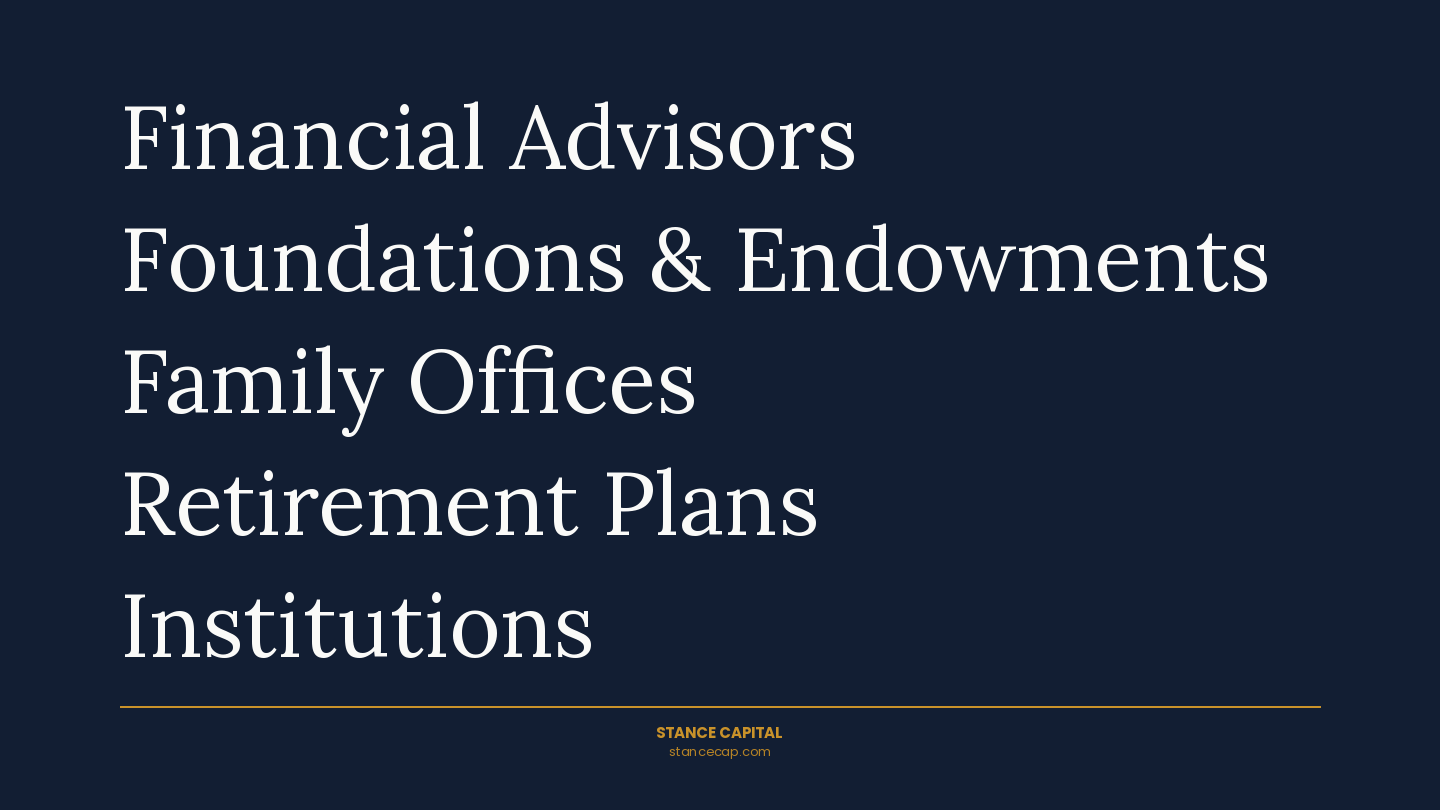
The Stance KB Global Biodiversity Strategy gives advisors a research-rigorous equity offering for clients who want to align capital with nature-positive outcomes without sacrificing investment quality. As biodiversity increasingly beomes a mainstream risk factor, accelerated by TNFD disclosure requirements and growing institutional attention, advisors who can offer this exposure will be ahead of client demand.
Endowments with long investment horizons are uniquely positioned to benefit from strategies that price in risks the market has not yet fully recognized. For endowments with environmental or conservation missions, the Stance KB Global Biodiversity Strategy also offers alignment between the investment portfolio and institutional values in a form that is analytically defensible, not merely aspirational.
Family offices investing across generations understand that the economic systems underlying long-term wealth creation are inseparable from the natural systems that support them. As natural resources become scarcer and nature-related regulations tighten, we believe the companies best managing their biodiversity dependencies and impacts are those best positioned to create durable value
Available where you already work.
30 minutes.
An honest assessment.
We’ll ask about your client base, your platforms, and the situations you’re trying to solve. We’ll tell you directly whether this strategy is the right fit.
Contact Stance CapitalPerformance data & strategy documentation
Complete performance history, portfolio characteristics, risk metrics, and compliance disclosures are available in the strategy documents below.
Documents coming soon
How does Stance KB Global Biodiversity approach environmental and biodiversity risk differently?
Environmental and biodiversity risks have historically been underrepresented in traditional investment management research. Stance analysts address that gap through industry-specific evaluation, benchmarking companies against a targeted set of environmental and biodiversity key performance indicators relevant to their sector. A company can appear well-positioned under conventional research frameworks and still carry significant, unpriced biodiversity risk. This strategy is designed to surface that distinction.
How do you handle a company with strong biodiversity practices that has had an environmental incident?
Incident history is a feature of our analysis, not a disqualifier on its own. We evaluate controversies in context: the nature of the event, whether it is isolated or part of a pattern, and how management responded. A company that acted transparently and remediated meaningfully may remain in the portfolio. One that minimizes the incident or allows it to repeat would not.
Does the strategy invest in companies that are not direct environmental stewards?
Yes. We maintain a category of "opportunity companies": businesses outside the highest-impact sectors that use their operations to advance biodiversity outcomes. These are often in technology, where companies deploy AI, earth observation tools, or data infrastructure inservice of conservation monitoring and species protection.
How does the portfolio evolve over time?
The strategy holds a focused universe of global developed-market equities reviewed continuously as company practices, controversy records, and financial profiles change. Biodiversity leadership can be lost, and the portfolio reflects that. It is not a static screen applied once at inception.
Is Stance Capital GIPS compliant?
Yes. Stance Capital is independently verified for GIPS compliance by ACA Compliance Group. Performance results are presented gross and net of management fees, and GIPS composite data is available upon request.
Go deeper on what drives this strategy.
¹ PwC. Managing Nature Risks: From Understanding to Action. April 2023. https://www.pwc.com/gx/en/strategy-and-business/content/sbpwc-2023-04-19-Managing-nature-risks-v2.pdf.
² IPBES. "Media Release: Nature's Dangerous Decline 'Unprecedented'; Species Extinction Rates 'Accelerating.'" May 6, 2019. https://www.ipbes.net/news/Media-Release-Global-Assessment.
³ University of Oxford, Environmental Change Institute. "$5 Trillion in Nature-Related Global Economic Risks Will Amplify Climate Change." December 13, 2023. https://www.ox.ac.uk/news/2023-12-13-5-trillion-nature-related-global-economic-risks-will-amplify-climate-change-oxford.
This page is for informational purposes only and does not constitute investment advice or a solicitation to buy or sell any security. Investments involve risk, including potential loss of principal. Past performance is not indicative of future results. The Stance KB Biodiversity Global strategy is available as a separately managed account; individual account results will vary. Stance Capital, LLC is a registered investment advisor. Registration does not imply a certain level of skill or training.