401(k) Fiduciary Investment Management
Most business owners who sponsor a 401(k) plan have thought carefully about the plan's contribution matching, the recordkeeper, and the enrollment process. Very few have thought carefully about who is legally responsible for the investment options sitting inside that plan. The answer, in most cases, is them personally.
Selecting and monitoring the fund lineup available to your employees is a named fiduciary act under ERISA. It is not an administrative function. It is not the recordkeeper's job. It is not automatically handled by whoever helped you set up the plan. If you have not formally engaged a qualified investment advisor to help you carry out that function, the investment menu is your legal responsibility and your personal liability.
This page explains what that means, who the parties in your plan actually are and what each of them does, and how Stance Capital serves as an ERISA fiduciary advisor for plan sponsors who want qualified investment guidance and a documented process for carrying out their fiduciary obligations.
What It Means to Be a 401(k) Fiduciary
ERISA, the Employee Retirement Income Security Act of 1974, governs employer-sponsored retirement plans in the United States. Among the many things ERISA does, it establishes fiduciary duties for anyone who exercises discretion or control over a plan's investments or administration.
The standard ERISA holds fiduciaries to is not the standard of a careful layperson. It is the prudent expert standard: the care, skill, prudence, and diligence that a knowledgeable investment professional would apply in the same circumstances. ERISA explicitly states that if a fiduciary lacks the expertise to meet this standard, they are expected to hire someone who has it. Not knowing enough about investments is not a defense against a breach claim. It is an additional reason for liability.
The implications are significant. Fiduciary breach claims under ERISA can result in personal liability, meaning your own assets, not just the company's, for losses suffered by plan participants. Standard directors and officers insurance typically does not cover ERISA fiduciary breaches. And fiduciary breach litigation in the retirement plan space has grown materially over the past decade, with settlements ranging from hundreds of thousands to tens of millions of dollars for plans of all sizes.
The most common source of fiduciary breach claims is not investment performance. Courts have held that fiduciaries are not sued for picking the wrong funds. They are sued for picking funds without a prudent, documented process. A plan sponsor who selected underperforming funds through a rigorous, documented review process is in a very different legal position than one who accepted the recordkeeper's default lineup and never formally reviewed it.
The Five Parties in Your Plan and Who Owns What
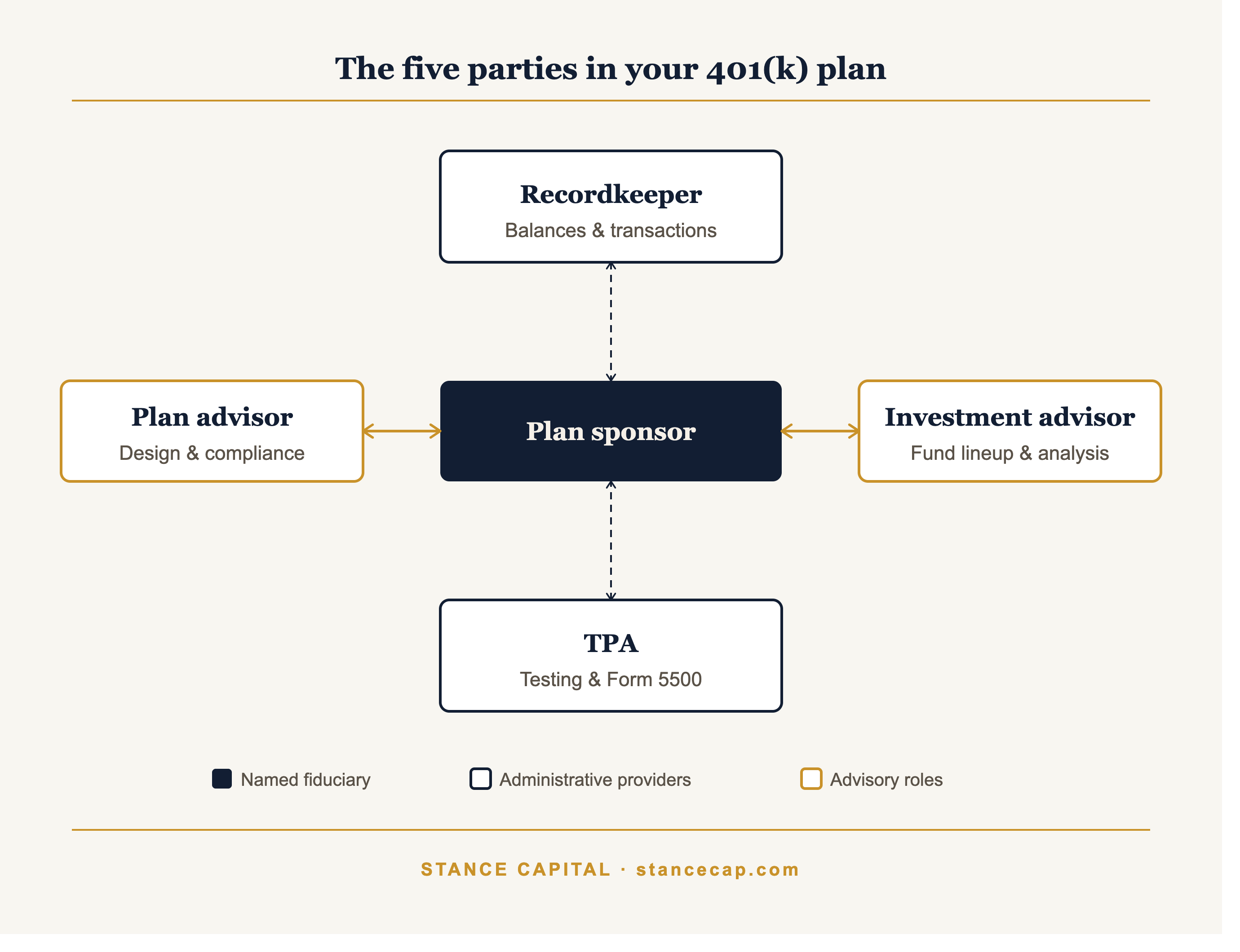
A common source of confusion among plan sponsors is the assumption that hiring a recordkeeper or a financial advisor has addressed their fiduciary obligations. It rarely has, or at least not completely. Understanding who does what in a 401(k) plan is essential to understanding where your residual liability sits.
The Recordkeeper tracks every participant's balance, contributions, investment elections, and transactions. When a participant decides to move money from one fund to another, the recordkeeper executes that instruction. What the recordkeeper does not do is decide which funds are available for participants to choose from. That decision, the construction of the menu, is a fiduciary responsibility. The recordkeeper is a service provider, not a fiduciary, for investment menu purposes.
The Third-Party Administrator (TPA) handles the compliance machinery of the plan: nondiscrimination testing, Form 5500 preparation, plan document maintenance, and required participant notices. The TPA is essential and often invisible until something goes wrong. The TPA is not responsible for investment selection.
The Plan Advisor serves as the employer's primary guide to operating a compliant, well-designed retirement plan. A qualified plan advisor helps with plan design, manages the employer relationship, monitors the overall health of the plan, coordinates service providers, and helps the plan sponsor understand and meet their obligations. The plan advisor may serve in a fiduciary capacity as an ERISA 3(21) co-fiduciary, providing investment analysis and recommendations while the plan sponsor retains final decision-making authority on all fund selections.
The Investment Advisor is specifically responsible for analyzing and recommending the investment options available to plan participants. This is a distinct role under ERISA, and it is the function that most plan sponsors either do not fill at all or incorrectly assume is covered by one of the other parties listed above.
You, the Plan Sponsor are the default fiduciary for anything not explicitly supported by a qualified service provider. You are always responsible for selecting and periodically monitoring every service provider you engage. When you properly appoint a qualified ERISA fiduciary advisor, you have access to professional investment analysis and a documented process for your fund lineup decisions. The investment decisions themselves remain with you as the plan sponsor, supported by that analysis.
The 3(21) ERISA Fiduciary Advisor: What It Is and What It Provides
ERISA Section 3(21) defines a co-fiduciary as an advisor who provides investment advice or recommendations to a plan, sharing fiduciary status with the plan sponsor. A 3(21) advisor delivers investment analysis and recommendations. The plan sponsor retains final decision-making authority on all fund selections and replacements.
This is meaningfully different from operating without any fiduciary investment advisor. A plan sponsor working with a qualified 3(21) advisor has a documented basis for each investment decision, professional analysis behind every fund in the lineup, and a structured annual review process. A plan sponsor without any fiduciary advisor is making those decisions in a vacuum, with no documented process and no professional support to point to if those decisions are ever challenged.
The plan sponsor retains final authority under a 3(21) arrangement. This means the fiduciary responsibility for the decisions you make remains with you. What changes is the quality and documentation of the process supporting those decisions. Courts have found that a prudent, well-documented decision-making process, supported by qualified professional advice, is what ERISA actually requires. The 3(21) structure is how plan sponsors can fulfill that obligation.
What does not change under a 3(21) arrangement: the plan sponsor's responsibility to select the advisor prudently, to monitor the advisor's performance on an ongoing basis, and to actually review and act on the recommendations provided. No professional relationship under ERISA removes the plan sponsor's obligation to engage with the process. But that obligation, evaluating your advisor's recommendations and making documented decisions based on them, is supported by professional recommendations and a documented decision-making process.
What Stance Does as Your ERISA Fiduciary Advisor
Stance Capital serves as an ERISA fiduciary advisor for employer-sponsored retirement plans. Our role is specific: we provide investment analysis and recommendations for the fund lineup. We evaluate the investment options available to your participants, monitor them on an ongoing basis, and provide documented recommendations when changes are warranted. The plan sponsor retains final decision-making authority on all fund selections.
Stance does not advise participants on how to allocate their individual accounts. We do not provide employee education or financial wellness services. We do not handle plan administration, compliance, or recordkeeping. Our function is investment analysis and recommendations for the lineup.
Building the Initial Fund Lineup
When Stance is first engaged, we review the existing plan investment options against the market, evaluate the lineup's composition across asset classes and risk profiles, assess the cost structure of current fund options relative to institutional alternatives, and determine whether the existing menu reflects a prudent, defensible selection process. Plans that come to us without a prior investment advisor typically have lineups that were either set by the recordkeeper at plan setup or reflect investment options that have not been formally reviewed for years.
We construct our analysis around criteria applied consistently: investment category coverage appropriate to the plan's participant demographics, fund-level performance evaluation relative to appropriate benchmarks, expense ratio assessment against available alternatives, manager tenure and organizational stability, and overall menu complexity. A well-constructed lineup is not the longest possible list of options. It is a thoughtful, appropriately diversified set of choices that gives participants what they need to build a retirement portfolio.
Annual Review
Each year, Stance conducts a formal review of the plan's investment lineup. This review evaluates each fund against its benchmark and peer group, assesses whether the plan's overall coverage of asset classes remains appropriate, identifies funds that have experienced meaningful changes in management, ownership, or strategy since the prior review, and benchmarks fees against the market to ensure the plan's cost structure remains reasonable.
The output of the annual review is a documented recommendation for the lineup going forward: retain, watch, or replace for each fund in the plan. When replacement is warranted, we identify the replacement candidate and the rationale. All of this is documented. The documentation demonstrates that a prudent process was followed and gives the plan sponsor a clear basis for the decisions they make.
Out-of-Cycle Review
Material events can warrant a review outside the annual cycle: a fund manager departure, a fund closure or merger, a regulatory change affecting a specific investment category, or a significant and sustained deviation from expected performance. We monitor for these events on an ongoing basis and provide recommendations when the facts warrant it, not only on a calendar schedule.
What You Receive
Plan sponsors working with Stance receive a documented investment analysis process and an annual written review of the plan's fund lineup. This documentation serves two purposes: it provides the plan sponsor with the professional investment analysis needed to make informed fund selection decisions, and it creates the documented record of a prudent process that ERISA requires.
How the Engagement Works
Stance works alongside a qualified ERISA retirement plan advisor who manages the employer relationship, plan design, compliance coordination, and participant services. The division is clear: the plan advisor handles everything about how the plan runs; Stance provides investment analysis and recommendations for the fund lineup.
This structure benefits plan sponsors in a specific way. The plan advisor focuses on the operational and regulatory requirements of running a compliant retirement plan. Stance focuses on investment analysis and its application to fiduciary investment management. Neither role substitutes for the other. Together, they cover the full scope of what a plan sponsor needs.
When Stance begins working with a new plan, the process is clear. The plan sponsor is introduced to our retirement plan advisory partner, who handles the engagement structure, coordinates with the existing recordkeeper and TPA, and manages the employer-facing relationship. Stance is formally appointed as ERISA fiduciary advisor, begins the initial fund lineup review, and establishes the annual review cadence. From that point forward, the plan sponsor's interaction with Stance is primarily through the annual review deliverable and any out-of-cycle communications when material events warrant attention.
Who This Is For
Business owners whose fund lineup was set by the recordkeeper at plan setup and has never been formally reviewed. This is the most common situation we encounter. A plan was established, the recordkeeper offered a default lineup, and no one has formally evaluated it since. The funds may be fine or they may not. Without a documented review process, the plan sponsor is exposed regardless of how the funds have performed.
HR directors and CFOs who have inherited a plan. Taking over responsibility for an existing retirement plan without inheriting the prior decision-making process is a fiduciary risk. A new fiduciary advisor engagement provides a documented process going forward.
Companies that have grown and whose plan now has material assets. The fiduciary stakes of a $2 million plan are different from those of a $20 million plan. As plan assets grow, the sophistication of the investment management process should grow with them.
Plan sponsors without a qualified investment advisor for the fund lineup. If you are not currently working with a qualified advisor who provides documented investment analysis and recommendations for your fund lineup, you are making those decisions without professional support. That exposure can be addressed by engaging a qualified 3(21) investment advisor.
Starting the Conversation
If your plan's fund lineup has not been formally reviewed by a qualified investment advisor, or if you are not certain who is currently responsible for that function, that uncertainty is worth resolving. The first conversation takes about thirty minutes. We will tell you directly whether the engagement makes sense for your plan size and situation.
Frequently Asked Questions
What does it mean to be an ERISA fiduciary?
An ERISA fiduciary is anyone who exercises discretion or control over a plan's investments or administration. As a plan sponsor, you are a named fiduciary for your plan's fund lineup. ERISA holds fiduciaries to the prudent expert standard, requiring the care and diligence that a knowledgeable investment professional would apply. Engaging a qualified ERISA fiduciary advisor gives you professional investment analysis and a documented process to support the decisions you make as plan sponsor.
Who is liable for my 401(k) fund lineup right now?
If you have not engaged a qualified investment advisor to provide documented investment analysis for your fund lineup, the decisions are yours without professional support behind them. The recordkeeper does not own this function. Your payroll provider does not own it. A financial advisor may provide some support, but that depends on the specific terms of their engagement and whether they are serving in a fiduciary capacity.
What is the difference between a 3(21) and a 3(38) advisor?
A 3(21) co-fiduciary provides investment analysis and recommendations. The plan sponsor retains final decision-making authority on fund selections. A 3(38) investment manager has full discretionary authority and makes the decisions themselves; the plan sponsor does not approve or reject fund changes. Stance serves as a 3(21) co-fiduciary: we provide the analysis and recommendations; you retain authority over the decisions.
Does working with a fiduciary advisor eliminate my liability?
No. Plan sponsors who work with a 3(21) fiduciary advisor retain decision-making authority and the associated fiduciary responsibility. What changes is the quality and documentation of the process supporting your decisions. Courts have found that a prudent, well-documented decision-making process supported by qualified professional advice is what ERISA requires. Plan sponsors remain responsible for selecting their advisor prudently and monitoring the advisor's performance on an ongoing basis.
Does Stance provide investment advice to plan participants?
Not within the plan. Stance's role is investment analysis and recommendations for the fund lineup, not participant-level advice about which funds individual employees should choose or how they should allocate their accounts. Participant-level services within the plan are provided by your plan advisor and, in some cases, by the recordkeeper's participant education resources. Separately, Stance does work with individual investors outside of the plan context. Any such relationship would be independent of the plan and entered into on the participant's own initiative.
How often does Stance review the fund lineup?
Stance conducts a formal annual review of the plan's fund lineup. Material events, including a fund manager departure, a fund closure, or significant and sustained performance deviation, may prompt a review outside the annual cycle. All review activity is documented.
What happens to our current funds when Stance is engaged?
Stance reviews the existing lineup as part of the initial engagement. In many cases, some or all of the existing funds are retained if they meet our evaluation criteria. We provide recommendations on changes where the analysis supports them. We document the rationale in both cases.
How do we get started?
Contact Stance directly. We will assess your plan's current structure, introduce you to our retirement plan advisory partner, and walk through what an engagement would look like for your specific situation.
Disclaimers
The information presented herein is for educational and informational purposes only and does not constitute legal, tax, or investment advice. ERISA fiduciary responsibilities are complex and fact-specific; plan sponsors and employers should consult qualified ERISA counsel and retirement plan advisors regarding their specific obligations. Stance Capital, LLC is a registered investment advisor. Registration does not imply a certain level of skill or training. Nothing herein constitutes an offer or solicitation for any investment product or service. Past performance is not indicative of future results.